
I require a lot out of my homemade mouthwash recipe. It needs to be minty, all-natural, whiten, & help remineralize my teeth. Here’s the recipe that actually does it all.
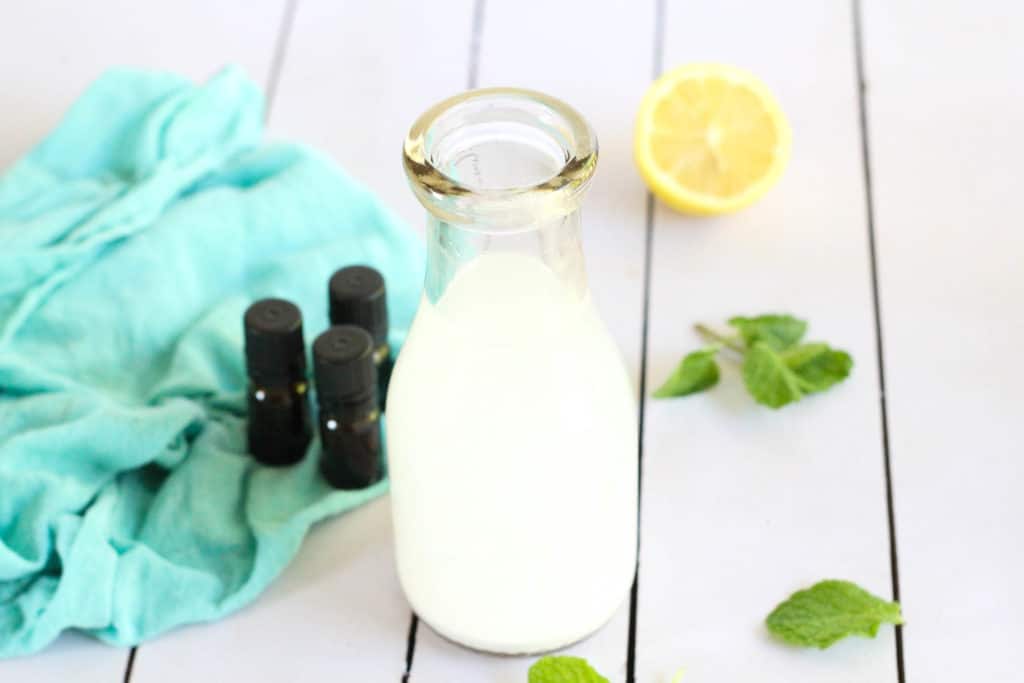
What makes the perfect homemade mouthwash?
I’ll admit: I require a lot out of my homemade mouthwash. All the artificial sweeteners and chemical additives in conventional mouthwash are a no-no in my book, but often “natural” mouthwash brands still don’t make the cut.
Either they aren’t really so natural, not very effective, or insanely expensive. Or they burn like unholy fire. Or sometimes all of the above.

My solution?
For a couple of years, I’ve been perfecting my own homemade mouthwash recipe.
Scroll down for the recipe, or check out the “why” behind all the ingredients below:
What I Look for in a Homemade Mouthwash
1. It must be minty. First and foremost – mouthwash should fight bad breath!
But I never went for the whole citrus mouthwash fad – and the herbal ones that taste like a snake oil remedy from 1894 aren’t my cup of tea either.
Of course, with homemade mouthwash, you get to choose the flavor – so it works no matter what you prefer.
2. It must be (a little) sweet. A touch of sweetness makes the whole mouthwash experience a little more pleasant. This is optional, so you can add more or less stevia, or opt out of it altogether if you’d like.
3. It should remineralize. Ideally, our saliva “bathes” our teeth in minerals to restore what might be lost through eating, drinking, and everyday life – this is how you keep your enamel strong.
Internal imbalances can interfere with this process (which is discussed in the book Cure Tooth Decay). I include specific minerals in this mouthwash recipe to help boost your saliva’s natural remineralizing process.

4. It should whiten. My teeth are battling coffee, chocolate, blueberries, tea, wine… they can use any extra whitening power they can get! This mouthwash is gently whitening to help fight everyday stains.
5. It should protect from cavities. All of the above measures help clean your mouth to prevent cavities from forming.
You can also add 1/4 cup of vodka alcohol if you like a “bite” to your mouthwash – and this will also help kill bacteria in your mouth.
With these five pillars in mind, I created my unique DIY mouthwash recipe below.
Why These Ingredients?
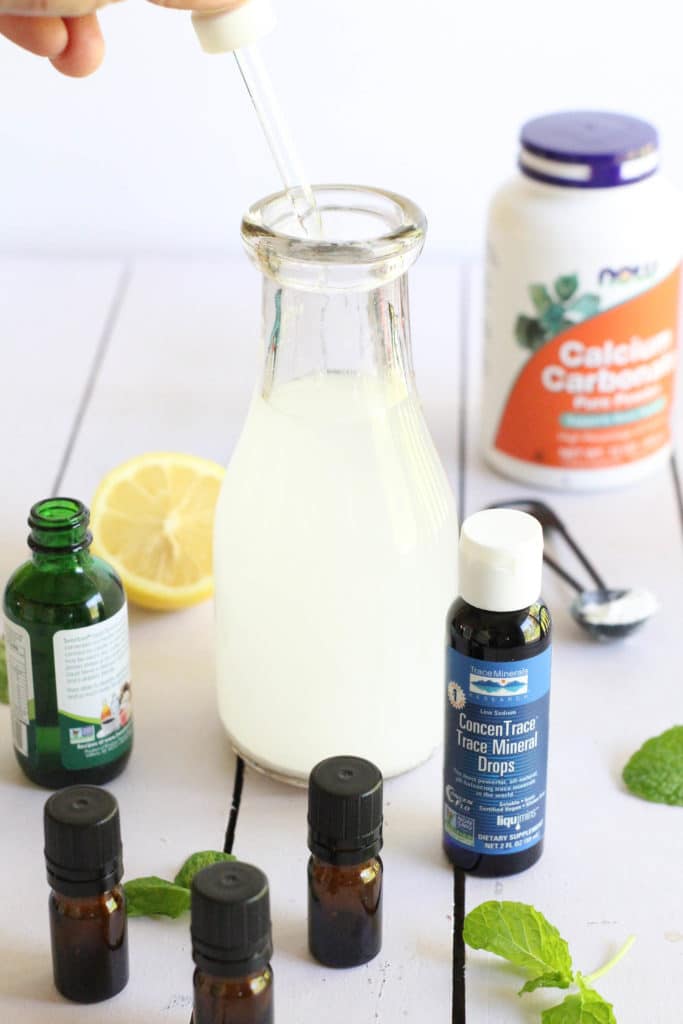
- Calcium carbonate powder: for remineralizing teeth
- Stevia: for sweetness without sugar (optional)
- Concentrated trace minerals liquid: for remineralizing teeth (buy here)
- Peppermint essential oil: for flavor and fresh breath
- Lemon essential oil: for whiter, brighter teeth
- Vodka alcohol: for that mouthwash “kick” plus germ-fighting ability
Ready to learn more about essential oils? Start my FREE SUPER SIMPLE 9-STEP EMAIL COURSE to start learning – without all the stress! I focus on the absolute essentials (pun totally intended, haha) and keep everything simple. That way you can learn what you need without information overload! Start my free course now.
How to Make Homemade Mouthwash
Ingredients
- 2 tsp calcium carbonate powder
- 40 drops trace minerals concentrate
- 10 drops liquid stevia
- 10 drops peppermint essential oil
- 5 drops lemon essential oil
- 2 cups water
- 1/4 cup vodka (optional)
Instructions
- In a large glass mixing cup, stir together the calcium powder and stevia.
- Add liquid minerals and essential oils. “Swirl” around until essential oils are absorbed into the calcium powder.
- Add water and stir.
- Pour mixture into a glass bottle (I reused an old apple cider vinegar bottle).
- Close the lid tightly and shake ingredients together for about 30-60 seconds.
- Shake well before using.
- Use as needed 1-2 times daily for 30 seconds.
Notes
Love It? Hate It? Need Some Help?
Have you tried this recipe? Do you have your own tips for making homemade whitening mouthwash?
If you have a question or comment, I’d love to hear from you! Share your thoughts in the comments section below this post.
More Articles for Healthy, White Teeth (the Natural Way!)
- Try this Black Oil to Naturally Whiten Teeth – It Really Works!
- Natural Whitening Toothpaste Recipe with Activated Charcoal
More Related Posts:
.png)
- Honey Face Mask
- Best Essential Oil for Skin
- Craving Peanut Butter
- Homemade Lotion
- Naturally Lighten Hair
- Lip Balm DIY
- Refined vs Unrefined Coconut Oil
- Raw Egg Benefit

Elizabeth is the founder of Nourished Live and has been writing about natural living for 12 years. Her work has been featured at Shape, Bustle, and Mother Earth Living. Her mission is to help you lower your stress levels and find fun ways to become happier and healthier. Read more about Elizabeth here.


Why does it need to stay in the fridge? I have sensitive teeth and using cold mouthwash is not appealing.
That’s just a precaution, to be honest. I personally throw caution to the wind and keep it in my bathroom. 😉
Good questions, Shannon! The calcium hydroxide might work, but I don’t have any experience with it. The essential oils might be enough to keep it stable, but I recommended refrigeration as a precaution. I personally just leave mine on the shelf in the bathroom.
I love the graphics on the bottle! That’s such a great label, except I guess having the word “recipe” on your product wouldn’t make much sense, but I think you should make this a printable and share it! Thanks for the recipe and links, since I wouldn’t know where to start to find the calcium. 🙂
Glad you enjoyed it! I like the label, too. I might have to print it out. 😀
I like the label, too. Where it says recipe, would be a good place to put the flavor.
Using the word “recipe” makes me think happy thoughts of Miss Emily and Miss Mamie Baldwin and “Papa’s Recipe” from “The Waltons.” 🙂
Where do u get your calcium carbonate powder?
I order online from stores like iHerb and Amazon.
Is there something I can use besides the lemon. I am allergic to lemons.
Thank you.
You can definitely leave the lemon oil out if you’re allergic. It’s there only for whitening. I’m not sure of other whitening essential oils, but some have had success with activated charcoal.
Chamomile oil has lightening effects.
Thanks, Tiffany! That’s good to know.
Clove oil is very beneficial for your gums and teeth.
Where do you get calcium carbonate?
I order online from stores like iHerb and Amazon. (There’s a link in the post to Amazon.)
think stevia drops would work in place of xylitol??
Yes, they would work for sweetness, but they don’t provide the potential cavity protection.
thanks! I wanted to ask the same question! great site, I just signed up to get your newsletter.
Take care,
Gloria
I’m confused! Nicole asks about using stevia instead of xylitol–but the recipe says stevia, doesn’t it? I was going to ask, why not xylitol instead, since xylitol too is supposed to be specifically good for killing bacteria, and for dental health. Can they be used interchangeably for this?
Xylitol can be used as well, but many of the readers on this site have asked for a xylitol-free recipe, so I added stevia instead.
When people are allergic to a food, for instance lemons, it is to the fruit. Essentials oils do not come from the fruit, but from the rind. As long as you are using certified pure therapeutic grade oils, you should be just fine. I recommend doTERRA essential oils company 🙂
First, therapeutic grade is a marketing term…… second, you can still be allergic to the lemon EO.
Yes, therapeutic grade is a term coined by DoTerra. But not so much as a marketing ploy, its bc they are the only company that does 3rd party testing to ensure their purity and safety regarding ingesting etc. “Therapeutic grade” is a reflection of that.
Secondly, while it is possibly to have sensitivity to certain EO’s that does not mean that bc you are allergic to X you will therefore be allergic to X EO. Just an example, my husband is allergic to eucalyptus, but has no problem using eucalyptus EO even neat.
Sorry, DoTerra is not the only company doing 3rd party testing, nor were they the first. Young Living Essential Oils have all been third party tested for years. Not only that but they do not outsource anything, as DoTerra does. Every oil they sell is guaranteed pure, grown and processed on their own farms and equipment for purity. I purchased Frankencense from both. Young Living is worth every $ spent. I can’t say that for any of the other brands I have purchased.
Young Living was started YEARS before DoTerra. In fact, DoTerra was started when a group of people left Young Living and started their own company. This is why everything DoTerra does mimicks Young Living. I am not saying that DoTerra is not a good company or product. Just stating the facts, unlike some others on here.
A group of people that worked for Young Living Essential Oils would use the knowledge and experience they had gained at Young Living to start their own company. So they took all of the terminology, methodology, marketing strategies, etc. and started doTERRA.
So, “therapeutic grade” and 3rd party testing were actually started by Young Living.
Would the lemon oil be hard on tooth enamel (citrus)?
I’ve thought about this and I’m not 100% sure, but here’s my theory: it’s the acidity of citrus fruits that causes problems for enamel. I don’t think the lemon essential oil is acidic (even if it was, the calcium carbonate in the recipe is alkaline and would neutralize it). So I’m personally comfortable using it on my teeth.
Hi! The acidity from the lemon comes from the vitamin c, which is water soluble, such as in the juice. The essential oil comes from the rind. Oil and water don’t mix, so you won’t find vitamin c in the oil. 🙂
On doing my own research for remineralizing tooth enamel , what I came across was if you are going to use lemon… like for lemon water, etc… that using the essential oil ( the kind safe for consumption) has the same health benefits of using lemon, without the damage to the tooth enamel.
I would say no. They use the rind not the actual juice from the fruit. You should be fine if you use a pure therapeutic essential oil. I love young living myself. Do your own research and make sure you check out the company. You get what you pay for.
How many uses do you get from one batch?
It makes about 16 fluid ounces, so it really depends on how much you use each time. I would estimate somewhere between 15-30 uses from this recipe.
some grapefruit seed extract might help preserve it at room temp and add some antibacterial action, as well.
That’s a good idea!
I think my husband will like this alternative much better than the tea tree oil I used last time! ?
Thank you for the recipe! I will have to work on rounding up the ingredientsto make this. Though I think I will use peppermint rather than spearmint. Unless the spearmint has a particular benefit. I am not fond of spearmint. I’ve used Listerine my whole life This would be quie a change. But I am getting to the age(63) I want to protect and keep my teeth in a healthier way as we are doing in other areas of our lives. Who knew there would be such horrors in our products these days.
You can definitely use all peppermint oil if you prefer–I just like the flavor of spearmint personally.
You could use tea tree instead of the spearmint (and I think replacing the peppermint as well) if you would prefer the Listerine taste. UGH
Tea tree also has antibacterial properties, and might help preserve it. (Not positive about that, but this it would.)
Unless you’ve used the blue Listerine which is minty!! Then use peppermint.
Personally I’m the opposite, I prefer spearmint. We all have different tastes.
You have to be careful to not ingest any if the mouthwash if using Tea Tree oil. It is poisonous if ingested.
The tee tree will do as you say and is a fantastic choice, however, the taste may be an issue twosome. My husband wasn’t to fond of it and I didn’t like it either last time I used it, I’m going to try grapefruit eo that a couple comments above suggested.
You might want to do a little more research into xylitol: http://www.thehealthyhomeeconomist.com/xylitol-not-as-sweet-as-its-cracked-up-to-be/
That’s a great article! Interesting insights. I definitely do not recommend eating or consuming xylitol. Any studies where it has offered anticavity benefits, it was used topically and not consumed.
I have read as long as its birch xylitol, its not a bad thing. 🙂
What is the best bottle to store this in?
Glass is best, so any glass bottle or jar will do. I use a 16-oz apple cider vinegar bottle myself.
Oohh! I have TONS of canning jars!! 🙂
Do you have a suggestion (product) for the essential minerals?
Thanks.
If you click on it in the ingredient list, there is a link to an Amazon product. I’m going to use MineralPal, another brand of concentrated (and desalinated) ocean water (which is where the trace minerals come from) because I already have a bottle that I use in my garden. Great stuff.
Thank you so much. I totally missed that those were links.
I should also ask how much grapefruit seed extract would one want to use with the rest of the ingredients. Thanks for posting this. It sounds really great.
Thanks.
From what I’ve read, about 10 drops in 16 fl ounces of mouthwash should be right.
Thanks very much.
Research says that the preserving effect of grapefruit seed extract is only due to the preservatives they put in it.
Check it out, they didn’t get any antimicrobial activity with homemade or 100% natural ones: http://www.ncbi.nlm.nih.gov/pubmed/10399191
Interesting, Jess, I’ll look into that!
I use 1-2 drops of GSE per serving in my mouthwash. Make sure you rinse well afterwards as the GSE will burn your mouth and strip the enamel off your teeth.
Thanks for sharing, I’ve been looking for something like this. Any reason to believe this should not be used by pregnant women?
Thanks!
I’m not totally sure. If I were pregnant, I would want to do a little extra research to be sure.
All these ingredients should be fine for pregnancy. The only one I was worried about was peppermint (not recommended for nursing moms) and some sources said not to ingest while pregnant. I contacted a certified aromatherapist and published author and she said small amounts (1-2 drops) of ingested oils would be fine (I asked for nausea). The trace minerals would be awesome for developing baby, but watch out, some trace mineral supplements exceed the recommended doses of arsenic, cadmium, and cobalt which are natural, but you don’t want much at all in your system.
So I accidentally bought Calcium Citrate…will it work? I haven’t opened it yet.
Calcium citrate is bound to citric acid, which is acidic. I’m not sure it would be recommended for your teeth.
Thats what I got from research, too. Thanks! 🙂
I wondered if I could use the eggshell powder I have made up in place of the calcium carbonate.
Egg shells are basically made of calcium carbonate, so that might work!
I do prefer using Wintergreen essential oil for these kind of products the taste is wonderful !
I believe wintergreen is not safe to ingest at all, so I recommend caution with that oil.